Leaks beneath concrete
Slab Leak Detection
When a water line under a concrete floor may be leaking, careful locating comes before any talk of breaking concrete. Here is how a suspected slab leak is evaluated in a Montebello home.
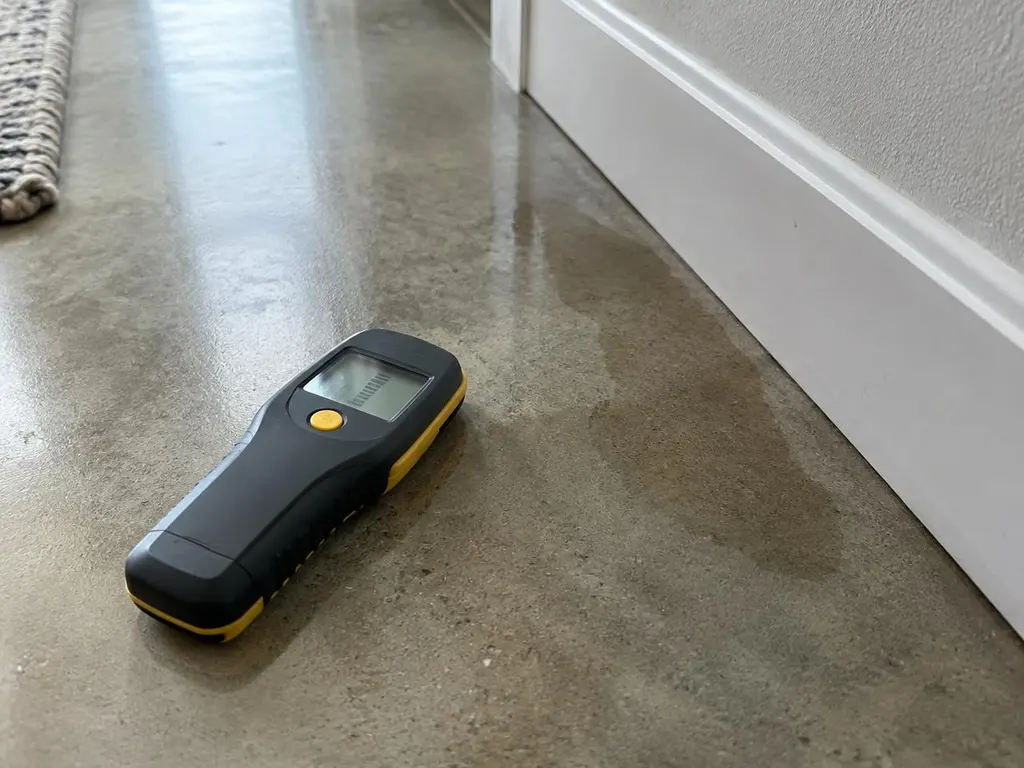
Not every home in Montebello is built on a slab, and not every slab hides old or failing pipe. But where water supply lines run through or beneath a concrete floor, a leak there can be hard to see and easy to misjudge. The goal is to answer three questions in order: is water really being lost, is it coming from a line under the slab, and where along that line is it escaping?
Signs are clues, not proof
These observations can point toward a leak under concrete. Each one also has other possible explanations.
- A warm spot on the floor — possible hot-water line leak; also sunlight, ducts, appliances or radiant heat.
- Damp or lifting flooring, or a musty smell — possible slab leak; also a drain, a toilet seal, a window leak or high humidity.
- The sound of running water with everything off — water moving somewhere; could be a toilet, irrigation or a water heater relief line.
- Higher water usage — check usage, not just cost, as explained in the high water bill guide.
- New cracks in flooring — usually settling or temperature movement; rarely conclusive on its own.
Rule out the accessible sources first
Before focusing on the slab, the easy-to-reach possibilities deserve a look: toilets that run or refill on their own, a dripping water heater relief valve, a washing machine hose, an ice-maker line or irrigation that runs overnight. Any of these can raise usage or cause dampness that seems to come from the floor.
Supply line or drain line?
Pressurized supply lines can leak continuously. Drain lines leak mainly when fixtures are used. That distinction changes the tools and the next step completely. If the moisture tracks closely with showers, laundry or dishwashing, a drain issue is more likely and the water leak vs. drain leak comparison is worth reading. If the meter moves with everything off, a supply-side leak becomes more likely.
How a slab leak is located
- Confirm loss. Meter observation and, where suitable, isolating hot and cold sides or sections to see which one loses pressure.
- Trace the route. Estimate where lines likely run beneath the floor from fixture positions and, where possible, line-tracing equipment.
- Listen and scan. Acoustic listening at the floor surface along the route; thermal imaging to look for warm patterns from hot lines; moisture readings to map dampness.
- Cross-check. Compare results. A location is more credible when independent methods agree.
Limits to expect. Thick flooring, tile, background noise, pipe material and very small leaks can make a slab leak harder to pinpoint. Thermal cameras read surface temperature only; they cannot see pipes through concrete. A responsible finding says how confident it is.
After the leak is located: options depend on findings
There is no automatic “tear up the floor.” The right path depends on where the leak is, the condition of the rest of the line and what sits on top of it.
- Targeted access and spot repair — opening a small area of slab to repair a single failure, when the location is well defined and the rest of the pipe appears sound.
- Reroute — abandoning the under-slab section and running a new line through walls or the attic. Often considered when access is disruptive or more failures are likely.
- Monitoring or further testing — when results are inconclusive or the loss is very small.
Each option has trade-offs in disruption, cost and long-term reliability. Repair and floor restoration are separate scopes from locating; the water leak repair page explains how those steps fit together. For a broader overview, return to leak detection in Montebello.
Questions to ask before anything is opened
- Which methods were used, and do they agree?
- How confident is the marked location, and how large an opening is expected?
- Is rerouting a reasonable alternative here?
- Who handles repair, and who restores the flooring?